Tuesday, April 1, 2014

A Walk around Town.....Part One.

Churchgate Station --- Flora Fountain --- St. Thomas Cathedral --- Horniman Circle & Asiatic Library --- Gateway of India (Apollo Bundar) --- Colaba Causeway --- Afghan Church --- Khau Gally (Churchgate) --- Snowflake's (Dhobitalao) --- K Rustom's Ice-cream Parlour (Churchgate)


Komal got a new camera and it isn’t always that one gets a holiday at the start of a work week. These two reasons prompted us to spend Monday morning rambling around town with our cameras in tow. Now, when we Mumbai-wallas say ‘town’ we’re usually referring to somewhere around South Mumbai but I’m only speaking of Churchgate and Colaba. It's summer already here in Mumbai, so I'd already prepared to battle the heat by digging out my old, cheap, light and over sized kurta to be worn on days I set out to quench my wanderlust.
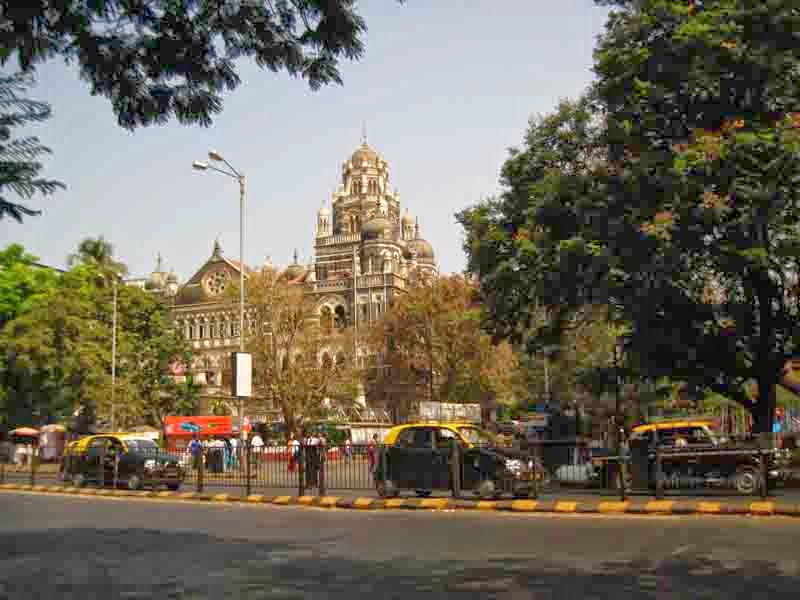
Leaving home at a little after 6 am, we arrived at Churchgate station which, at that early hour was almost deserted. Being residents of Mumbai, we do know our way around town, but nonetheless, I stopped at the Wheeler store and picked up a cheap, yet informative guide book which give information about all bus routes, train time-table, taxi fares and a fairly good tourist map for South Mumbai and the Suburbs. Tucking the book into my jhola (a sling bag made of cloth) and camera in hand, we began our walk at close to 6.40 am.

Our first stop was the exquisitely carved historical monument dedicated to the Roman goddess of spring, Flora. This fountain, designed by Richard Norman Shaw, was unveiled as Flora Fountain in the year 1864. The majestic statue of Flora stands atop the beautiful fountain located at the southern end of Dadabhai Naoroji Road, also known as Mile Long Road. This area also known as Hutatma Chowk (Martyr’s Square) is commonly known as Fort since the place where Flora stands is the exact spot where the original church gate of the Bombay Fort stood before the walls it was demolished in 1860. At peak hours, this spot is extremely noisy and polluted with smog and noise, but in the early hours of the morning, it’s a pleasure to sit a while and enjoy the beauty of Flora and the many crows that come to take a dip in the waters of the fountain.


Walking a few meters away from the fountain, we stopped next at St. Thomas Cathedral; Bombay’s first Anglican Church built in 1718 to cater to the religious needs of the British. One of the gates of the East India Company’s Bombay Fort was also the entrance to St. Thomas. Hence the nearby station is called Churchgate. Today, the street leading to the church is known as Veer Nariman Road. The foundation stone for this church was laid in 1676 but it was opened to the public on the Christmas of 1718. This church was consecrated a Cathedral in 1837. Within its cool and peaceful interiors, many a British officer, generals, clerks and maids are laid to their rest beneath ornately carved tombstones bearing eloquent elegies. There are also many spectacular stained glass windows that cast a serene riot of color across the tombstones and the stone floor of the cathedral. There is no fee to visit this pretty and historic monument, but it is a place of worship and must be treated as such. Photography is permitted and one cannot help but remain silent in awe of the calm that pervades inside this church. Here, one can actually believe that the dead are at peace.
Main Altar
Entrance

Pews


Stained Glass Window
The Word for all


Just behind this Cathedral lies the large, circular garden known initially as Elphinstone gardens. Today, we know it as Horniman Garden Circle, in honor of Benjamin Horniman, the editor of the Bombay Chronicle and a supporter of Indian Independence. The garden, planned in 1869 and completed in 1872, was a favorite social venue for the Parsi community and, in a live band used to perform here every evening in the pre-independence period.
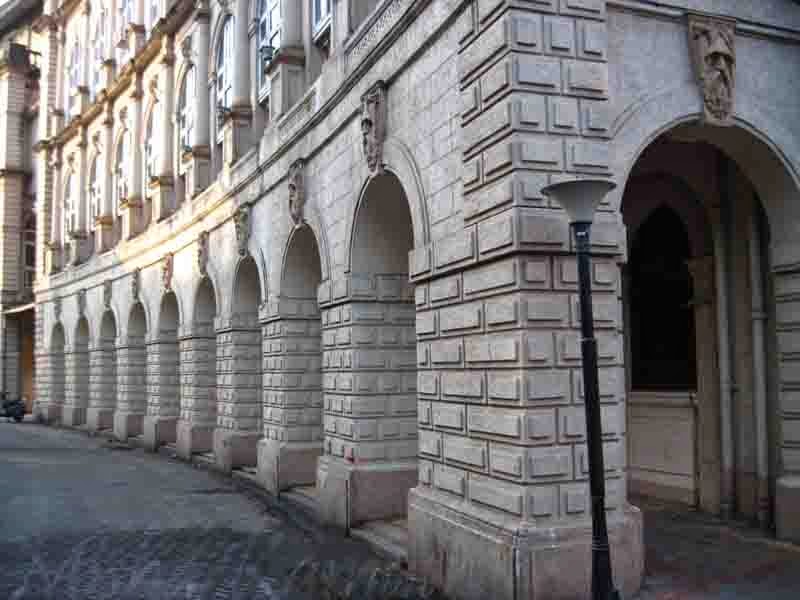


The Asiatic Society Library & Town Hall overlooks the Horniman Garden Circle. It houses over a hundred thousand books of which at least 15,000 are rare and valuable pieces. The library is also home to one of the only two known original manuscripts of Dante’s Divine Comedy. Other that books, the library has many artifacts, manuscripts in Persian, Prakrit and Sanskrit, and also a numismatic section containing 11,829 coins. It has a map collection of 1300 maps. Although quite popular, the membership has dropped considerably due to the availability of information on the internet.

Walking down the many stairs leading to the Asiatic Library, we walked along the naval dockyard towards the Apollo Bandar. Being a defense area, photography isn’t encouraged, but I simply had to get a shot of the murals painted on one of the walls. En route to the Apollo Bandar, one also passes another heritage monument, which is today the Maharashtra Police headquarters and some other beautiful pieces of architecture, that make you wonder at the artistic sense of the British.
Murals


Police Headquarters
The Gateway of India, a monument built during the British Raj in Bombay (today known as Mumbai). The 26mtr high structure located at Apollo Bandar was built to commemorate the arrival of the British King George V and Queen Mary in 1911. Its design is a combination of hindu-muslim style of architecture and is a very popular tourist destination. 
The Gateway of India


The Taj Mahal Palace and Tower Hotel
It is here that one boards ferries headed towards Alibaug and Elephanta. There are five jetties at the gateway, of which one is no longer functional and two are closed to the general public. Sitting in the shade of the arched monument, we had a light breakfast and watched the slowly growing swarm of tourists as they posed for pictures, fed the pigeons, waited for the ferry or just sat around enjoying the sight of the Taj Mahal Palace and Tower Hotel. At night, this monument is lit with the colors of the Indian Tri-color and it was from this very spot that the British departed India on 28 February, 1948.

Having rested a while, we moved on towards Colaba Causeway, a usually bustling tourist shopping hot-spot, which, at that time of the day (approx’ 9.30am) was still asleep. We were headed to the Afghan Church, which is located in Navy Nagar. On learning that it was an extremely long walk ahead, we took the bus to our next destination of choice.

The Church of St. John the Evangelist, better known as The Afghan Church is an Anglican church in South Mumbai, built by the British to commemorate those who died in the disastrous Afghan War of 1838. Built of buff-colored basalt and limestone on the outside, we found this church rather beautiful with a haunting quality to it. Since the doors were all shut, we took a walk around the church and I must say we were very shocked at the amount of garbage that is strewn around the churchyard. We were rather dejected at not being able to enter the church and had just whispered a prayer towards Heaven, when we spotted one of the side-doors being opened by the caretaker’s wife. Requesting permission to enter for just a few minutes, we quickly shut the door behind us.


As opposed to the serene air that hangs over St. Thomas, the interior of this ancient church seemed heavy with a nameless feeling that I find unable to describe in words.  This could be because of the deafening silence and the almost dark and gray interiors. The only light was that that filtered in through the long, narrow windows and the stained glass panel at the east end of the church. Everything has an eerie feel here…the pews, the altar, the panels and the pillars. I could actually imagine Englishmen and ladies walking down its aisles and half expected to find some veiled figures sitting in one of wooden chairs, head bowed as if in prayer.  Komal says the place gave her the creeps, but, in spite of its slightly haunting quality, personally, I found the church quite arresting, especially the altar.
Out in the sunshine, it’s peaceful and bright with the sunlight streaming through the trees and the dried, yellow leaves strewn around at our feet. We sat awhile under one of the many banyan trees that dot the churchyard. While my companion wandered around clicking pictures, it occurred to me that while life continued beyond the walls of this church, here, time seemed to be still.

High Court
We then boarded bus route 103 and alighted at Regal. Our plan was to walk from here towards Churchgate station, admiring the lovely architecture that was all around us. This crescent shaped precinct, known as Kala Ghoda, is full of museums, art galleries and heritage structures. Here, one will find the Prince of Wales Museum (now known as Chattrapati Shivaji Maharaj Vastu Sangralaya), the National Gallery of Modern Art, the Arts Trust and, my favorite, The Jahangir Art Gallery.  We turned left at Watson’s Hotel, now known as Esplanade Building, India’s oldest surviving cast iron building, and stepped onto the Karamveer Bhaurao Patil Marg, with the Oval Maidan on one side of the street and the imposing Mumbai University and High Court on the other. 
The Oval Maidan

Mumbai University
Founded in 1857, the Mumbai University was established by Dr. John Wilson. The famous Rajabai Clock Tower standing 280 feet tall and was modeled on London’s Big Ben and is reported to have played 16 tunes. At a height of 30 feet from the ground, I’ve been told there are eight statues representing various Indian castes. Since the tower is currently undergoing some restoration work, I was unable to get any pictures. Well, there’s always another time!

Since it was lunch-time, we headed for Khau Gally, a tiny lane packed with tiny eateries catering to the busy Mumbaikar who’s looking for a quick, tasty meal. Here, one can feast on chaat items like sev-puri and bhel-puri, or enjoy some hot pav-bhaji or noodles and fried rice. Mini meals of vegetable, pulses and rice/roti are also available at a nominal price. If you expect to dine in style, then Khau Gally isn’t for you. Meals are eaten standing at the stalls while the rest of the world passes by.


Although I enjoy street food and have absolutely nothing against eating on my feet, I had my heart set on another place I always frequent when in town. Located in a by-lane at Dhobitalao, close to Marine Lines station, this 80 odd year old restaurant dishes out simple, yet delicious Goan fare. So, if you have a craving for some spicy fish-curry-rice, rechadio bangda or roast beef and pork vindaloo, head to Snowflakes


Originally owned by one Mr. Joaquim Pascal Ribeiro, this tiny family-run restaurant has a cozy home-like feel to it. There are old wooden cabinets, family photographs, marble topped tables and wooden chairs. Frequented by the many Goans who live in the neighborhood, Snowflakes tops my list of favorite places to dine at.

For dessert, we walked back towards K. Rustom Ice Cream Parlor, a 54-year old landmark located near Stadium House on Veer Nariman Road. 


Famous for its ice cream sandwich, a thick slab of ice-cream placed between two wafer biscuits, K Rustom’s offers more than 35 exciting, lip-smacking flavors all made at the parlor itself. Lacking the frills of modern ice-cream parlors, Rustom’s still holds on to its old-world charm and hospitality as it serves its signature sandwiches encased in butter-paper. A trip into town, for me, is incomplete without a gobbling at least two of Rustom’s ice-creams.

Our bellies filled, all we could do now was sit in a train and make the journey back home. There was much more I’d hoped to do, but I’ve put it aside for another day. For now, we’d had an enjoyable morning and wanted nothing more than a nice bath and some sleep.

Total expenditure-Rs. 320/- only. Not bad for an entire morning of fun, isn't it?


Pics by Misha.

Tuesday, March 18, 2014

Chikki-land!


Expecting a nice, long weekend for Holi, we planned ahead and book ourselves a weekend at Lonavala. Known for its many varieties of chikki, a hard candy, Lonavala was discovered n 1871 by Lord Elphinstone, the then Governor General of the Bombay Presidency.

 This time, since our destination is just a 3 hour drive from Mumbai we left home at 8 am. Driving was fairly smooth until we got off the highway and turned towards the Goa-Pune road. There’s quite a bit of construction going on along the entire stretch of the road on account of which the traffic is almost at a standstill, Inching our way forward, we finally got on to the Vashi bridge and from then on it was smooth sailing for us. One crosses 2 toll booths while heading towards Lonavala, Rs.30 and Rs.165 respectively.
Although it was a fairly pleasant drive, we found the heat unbearable when we stopped for breakfast at the Food Plaza. There’s quite a variety available here and to say it was crowded would be an understatement. The entire place was teeming with cars and people all out to enjoy the long weekend. For a total bill of Rs.170/- we had a dosa (the Indian version of a crepe), medu wada, coffee, some corn, and a dabeli, a snack made of bread stuffed with a sweet and sour filling. There’s also a KFC and Subway available across the road, but we decided to stop there on our way back from our trip.
Fare chart (as on March 2014)
Driving on, we soon passed through Khandala and arrived at Lonavala. Dotted with pretty villas and abundant greenery, one can easily recognize Lonavala by the numerous chikki shops that line the streets. Our final destination was another 5kms away, at Karla. There’s another toll booth to be passed here (Rs. 39 for a daily pass). Then, when you least expect it, you’ve got to take a sharp turn and along a 1/2km stretch of narrow, shaded lane to enter the MTDC Resort, Karla.

Tourist Information
MTDC Resort, Karla: The Maharashtra Tourism Development Corporation (MTDC) always seems to get the best locations, albeit a little away from the hub of all the activity, but this is perfect if one wishes to take a break from the rush of the city. This particular one is larger in area and offers more facilities than others. As it always is with MTDC resorts, there are plenty of trees and shaded pathways. Many types of rooms are available to suit the visitor’s needs. Each cottage/room has ample of parking space and the rooms, although quite minimalistic, are comfortable and clean. Apart from cottages, the resort also has its own restaurant, an ayurvedic massage parlor, boating facilities and a water park. There are also some well-equipped play areas for children.The slides and other equipment in these children's play-areas are clean and well maintained, thus ensuring that kids also have something to keep them occupied during their stay.


Our cottage looked out onto a field and the highway in the distance beyond that. I did initially find the room a little stark and would have preferred some happy pictures on the walls, but consisting of a bed, a dresser, television and two couches, the room was exactly what we needed since we planned to spend most of our time exploring what Lonavala had to offer.
Having settled in, we began our day with a relaxing body massage at the very picturesque ayurvedic
massage centre. Painted a bright green with yellow interiors, the parlor looks very inviting and the fragrance of various herbal oils enveloped us as soon as we entered. The massage treatments are done in a little room at the back of the reception area. The masseuse seemed to be quite experienced and the massage itself was very soothing. The experience would have been better if I wasn’t too aware of the curtain that kept flying open with every gust of breeze. Also, there was this constant buzzing sound that had me of hidden cameras.

Lunch at Rohit’s: For lunch, we stopped at a wayside restaurant that goes by the name of Rohit. According to its signboard, it also lets out rooms and has a swimming pool, but personally, I’d say the location isn’t all that good. I mean, would it be comfortable swimming in a pool that is bounded by a busy crossroad? Anyway, we just wanted lunch and ordered a chicken thali and some mutton masala and rotis. What was served to us was delicious and quite filling. The chicken thali itself consisted of three large rotis, rice, dry chicken, egg curry and gravy. Our total bill for lunch, inclusive of a soft drink, was just Rs. 425. Mention must be made of the quick and friendly service by the staff. Surely a place to try if you don’t mind oily food as long as it tastes good.
Next, after a much needed bath, we drove 5kms to Lonavala, a busy bustling town that now has all the latest restaurants and fast food joints that a city dweller is used. What it does lack is planning. There are absolutely no direction markers or signboards anywhere. Tourist maps are unavailable and even the locals seem absolutely unaware of directions or scenic spots. It’s quite surprising that a much visited tourist destination is so unorganized!

Spotting a poster advertising a Wax Museum, we decided to pay a visit and see how it sized up to the one we had seen at Hong Kong. Well, Mme. Tussaud’s it isn’t, but it really was worth paying Rs.100 to see the few exhibits that were displayed. Comprising of wonderfully sculpted models of famous Indian personalities, the artist, Mr. deserves applause. Of the three non-Indian personalities, only Mandela seems almost true to the original person. MJ and Angelina Jolie are not recognizable, save for their clothes. The parking attendant at the Wax Museum is an extremely cheerful chap who doubles up as a tourist guide. He greets everyone with a, “Hello, Sir. Hello, Madam. Welcome to Wax Museum” all said in one breath and in the same slightly nasal tone and a smile that actually touches his eyes. You just have to ask him where any random spot is (we asked him where Sunset Point was) and he begins this long litany giving you the highs and lows of every tourist spot in Lonavala and Khandala and also provides you with driving directions for each of them.

For dinner, that evening, we drove to the Kinara Village Dhaba, a rather crowded eatery along the highway itself. What makes it popular is the ambience. The entire place is modeled after the rural villages of India. All around ate thatched huts, wooden gazebos and rustic tents. The place is lit with lanterns, fairy lights and chandeliers casting pleasant shadows while people sit around tables on woven cots and benches. There is live Indian music being played as patrons dine, chat and enjoy camel rides. It’s like an Indian fairy land, but there’s usually a long wait for a free table. Our plan was to wake up early and catch the sunrise, so we had dinner at the neighboring Sheetal Dhaba where the fare is good, service is a tad bit slow, and the prices are slightly steep, especially for the flavored lassi in five shot glasses is Rs.250….that’s Rs.50 for three sips!!! You won’t be missing much if you skip that.
With that, we headed back to the resort and called it a day. I was glad to have had such sound sleep especially since I have an extremely active imagination and, when travelling, keep imagining all sorts of spirits and ghouls haunting the room. This usually keeps me up for most of the night, but this time I was spared the agony on account of a tiring day.

5.30am. We began driving towards Lion’s Point, which is said to be a good place to catch the sunrise. It’s a fairly long drive and almost missed the spot if it wasn’t for the many cars parked off the road. It was windy, pleasantly cool and a hind of pink had just began to appear in the sky, but what could have been a breath-taking experience was ruined by the loud, crass and obviously drunk crowd of people that had assembled there. The silence of the morning was murdered by blaring music and raucous laughter. The entire place is horribly littered with plastic wrappers and packets, paper plates, empty liquor bottles and all sorts of garbage. There are no dustbins and it is shocking to see that the tourism department allows such gross misbehavior. We tried trekking a little higher to get away from the disturbing environment, but in vain. 

Disgusted with the experience, we drove back down the mountain and decided, at the spur of the moment, to stop at Bushi Dam. The many stalls that lined the rocky path leading to the dam were still shut and we were the only living souls standing there in the early hours of the morning. A steady trail of garbage and empty bottles lay as silent witnesses to the many visitors who frequent the place during the day, ignoring that, we continued towards the dam and, crossed the huge stone wall and seated ourselves under the trees, watching the sun rise slowly above the distant hills. I’d say this is by far the best place to catch the most perfect, golden sunrise.
Sunrise at Bushi Dam


After drinking in the beauty of the morning sun as it danced on the lake, we spent the next half hour relaxing in a paddle boat. The Indrayani river is beautiful. Sitting there, idly drifting, I remembered the famous lines from the Ancient Mariner….
Day after day, day after day, we struck nor breath nor motion
As idle as a painted ship upon a painted ocean.
The river offers views that could easily be the subject of an artist’s painting…..clear waters, cottages with picket fences, bougainvillea in full bloom and graceful swans….an absolutely beautiful scenario!

Breakfast at MTDC’s Indrayani Restaurant is good and moderately priced, but like every government run establishment, here too, there was an element of chaos and lack of planning. The waiters seemed quite harried and orders took an awfully long time getting to the tables. From what I gathered by the snippets of conversation I could overhear the restaurant seemed to be understaffed and unable to cater to the huge crowd of visitors that weekend.

After a short nap to make up for the early morning tryst with nature, we drove 5kms towards the Karla Caves. These ancient Buddhist caves are one of the oldest rock-cut caves and are visited by hundreds of tourists daily. Many of these tourists are pilgrims who climb the 150odd steps to pay homage to the Goddess Ekvira, whose temple is just a few feet from the entrance of the ancient cave. In fact, it almost blocks the entrance. For those not wishing to climb all the way from the base, there is a steep, motorable road that takes you
halfway up the hill. There’s a 30Rs toll at the foot of the mountain and another 10Rs towards parking charges. From there on, visitors must continue on foot. The climb is rather tedious, but one can stop at the various stalls along the way and purchase religious articles, sweetmeats, toys and even click a picture with a stuffed tiger.

Having no wish to visit the temple, we headed straight for the caves and what we saw was truly amazing. Intricate carvings adorned the entrance and the entire inner hall was supported by huge stone pillars atop which sat shapely figures astride elephants.

Lunch was back at the hotel in the resort. We ordered a mutton biryani which I must say was really tasty. A nice siesta and we were back on the road towards Khandala, eager to catch the sun before it set. Sunset Point is located right on a busy road. People park their cars along the side of the road and stand staring out at the sun as it slowly makes its descent beyond the mountains in the distance. If you’re lucky you get to see the sky light up with wonderful shades of pink and purple. We weren’t so lucky and saw the sun disappear behind a smoggy horizon, but we did manage to get a few good pictures.
Dinner was at the newly opened Yoko’s and then it was time for bed. The next morning we sat a while at the jetty and bid a silent farewell to the peace and quiet of the countryside before driving back to Mumbai.  
 Being the festival of color, Holi, the streets were deserted and we made it home in just about an hour and a half. A smooth end to a wonderful, much-needed weekend!


Pics by Misha & Akshay.

Monday, March 10, 2014

Elephant...Ah!


More than a decade ago, a group of cousins had taken a trip to the Elephanta Caves. Unfortunately for them, it was the monsoon season and a sudden storm arose. Hurrying into the last ferry off the island, the group could only hope and pray that they reach home safely. After a harrowing boat ride, many tears and heartfelt prayers, they landed safe and sound at one of the ports in Mumbai. This was surely an experience that shook us all and one that I haven’t forgotten. But last week, my brother suggested we spend a Sunday at the very same Elephanta Caves and, brushing aside the memory of a stormy sea, I heard myself saying, “Why not?”

So, on the morning of Sunday, March 9th, 2014, we left home to board a train to Churchgate Station. From there, we took a cab to the Gateway of India (Taxi fare, Rs. 27). We were on our way to the Elephanta Caves for which we first had to book our ferry tickets from one of the many booking outlets that dot the pavement. (Ferry fare, Rs. 150 per head for a return ticket)
The ferries to Elephanta leave from gate no. 4, which is right behind the gate. These ferries ply at regular intervals of 5-10 minutes with the first one leaving at 9 am. It is advisable to take the early ferries as the crowd isn’t too much then and it’s easy to find seats on the upper deck. There’s an extra charge of Rs. 10 for those wishing to sit on the upper deck. I thought that was cheap until, I heard a foreign tourist telling his companion the plastic seats were the best they could expect for 12 cents. 10 rupees for us was 12 cents for them! Wow!
Anyway, we punched our tickets, paid our ’12 cents’ each and boarded the second ferry and, having found some comfortable seats, began our ride towards Elephanta.

LOCATION
The Elephanta Caves are a network of sculpted caves located on Elephanta Island, or Gharapuri (meaning, Place of Caves), 10 kilometres to the east of the city of Mumbai. Although there are ruins of one or two Buddhist caves & stupas here, it is said that, the island was once a Hindu place of worship until the Portuguese rule began in 1534. The Portuguese called the island Elephanta on seeing the huge statue of an Elephant at the entrance. (The Statue is now placed in the garden outside  what is today known as Jijamata Udyaan (formerly, Victoria Gardens) at Byculla in Mumbai. Historians have dated these caves as belonging to late 5th or 8th century. Although many of the sculptures are still clearly visible, most of them have been badly damaged and restoration work on these caves is underway.

ELEPHANTA AHOY!
Visible trails left by mudskippers
After an hour long ferry ride, sans choppy waves and madly rocking boat, we finally weighed anchor at the Elephanta Jetty. If my memory serves me right, the last time I’d visited the place, there were just a few stalls and some dusty, old caves. Things have improved since I last visited Elephanta.
(pic' ...tripadvisor)
It’s usually quite a long walk from the jetty to the caves, but MTDC has made available a mini-train service to and from the jetty. It’s a pleasant ride aboard the little, toy-train and it truly beats walking, as the return fare per person is only a mere Rs. 10. The toy-train ride is a fairly short one, but there’s enough time to click a few pictures and watch the mudskippers as they flit about on the marshy sand beside the tracks.

The train drops you off at the end of the jetty where one has to pay a Tourist Tax levied by the Gram Punchayat of Gharapuri (Rs. 10 per adult). Now begins the climb towards the caves.
There are a hundred and twenty paved steps leading to the caves. The entire pathway is lined with stalls and little restaurants on either side. These stalls mostly hawk trinkets, pearls, cheap hats and key-chains. There are also some handicraft and handloom stores, including one run by the Maharashtra Tourism Development Corporation (MTDC).
Dolis
One good thing is that the entire stairway is covered and well-shaded, thus cutting off a lot of the heat and making climbing up a little less tiring. For those who would still like to avoid the climb, there is a Doli Service available for the fee of Rs.120/-. This would mean sitting on a sturdy wooden chair while four men hoist you up on their shoulders and deposit you at the top of the hill. This is a form of livelihood for the local villagers, but, finding the entire process a little in-humane, we chose to let our own legs carry us to the top.
I do not, however, condemn those who do hire the services of these dolis. 
After all, it is just a means of earning a living for the poor locals, who, I must add, are quite ingenuous when it comes to self-employment. Once you get to the top of the stairs, just outside the MTDC booking office, there's a woman who stands with an empty pot, pretending to fill water at the tap. She stands there requesting the tourists and visitors to click a photograph with her. Visitors who indulge her are then asked for money. She asked us for Rs. 50, we gave her 10. Some gave her much more, others gave nothing. But from the little I saw while waiting for my ticket, she seemed to be doing good business.


THE CAVES
Once you get to the top, the shade and the calls of the vendors ceases and you have to head to the small MTDC booking office to purchase an entry ticket to visit the caves. The charge is Rs. 10 for Indian visitors and Rs.250 for foreign tourists. At first glance, this would seem like a huge price difference, but then I remembered the '12 cents' aboard the ferry and realized that given the exchange rate and the fairly low value of the Indian Rupee, Rs. 120 is still a very nominal price to pay.

There are 5 rock-cut caves on Elephanta, one of which lies unfinished by the original builders. These caves served as shrines to Lord Shiva, and till today, pilgrims come to visit these shrines on Mahashivratri.

The Main cave is the most elaborate and impressive of all 5 caves. It consists of a huge hall supported by six rows of columns, with six columns in each row. This pattern is broken only to house the shrine of Shiva. The noteworthy feature of these columns is the pot-shaped capitals with which they are adorned.

The shrine in the main cave has a large Shiva Lingam, guarded by a total of 8 Dwarapalas, or gatekeepers carved into solid rock.

All sculptures in the cave depict Shiva in various forms and moments. There’s Nataraja (Shiva as the Lord of the Dance), Shiva killing the demon Andhakasura, the Gangadhara Shiva (Shiva carrying the Ganges), Ardhanarishwara (Shiva & Parvati in one form) and Yogishwara (Shiva in meditation). There are also panels depicting the marriage of Shiva and Parvati (Kalyanasundara Murti) and one of Uma Maheshwara, Shiva and Parvati engaged in a game of dice.
The most impressive of all the sculptures has to be the Mahesh Murti, or the Trimurti, as it is commonly known. This Mahesh Murti depicts the three forms of Shiva.
To the right is the visibly angry expression of Shiva to represent Shiva as the destroyer. The figure on the left has a calm expression and relates to Shiva as the Preserver, and the Figure in the center depicts Shiva as the creator of the universe and life.

Other than the caves, another attraction at a walking distance of about 1km is Cannon Hill. It’s said to be a good place to get a view of the Arabian Sea that surrounds the island and is so named because of the huge cannons left behind by the Portuguese. These cannons are fixed to a large circular dais that actually rotates a complete 360 degrees, thus enabling the Portuguese to defend all sides of the island.
We were too tired to climb all the way to Cannon Hill, so stopped half way and enjoyed a refreshing glass of fresh lime soda and kokum soda at a stall along the way. As we sipped on the simple drink, we chatted with the owner of the stall and he gave us some information of the village he lived in and the two other villages that called this island home.

OTHER SNIPPETS OF INFORMATION
Most tourists spend maximum time in the main cave as there is much to see there. The other caves only sport some columns and doors carved into the rock. But the place is worth a visit and one can easily spend a leisurely morning exploring the sights the island has to offer. The place is clean, cool and infested with monkeys.

Visitors must be careful of the many monkeys that constantly bound from tree to tree. They’re harmless, but are more than ready to pounce at you and grab any tasty morsel of food that you might be carrying in your hand.

A good thing about Elephanta is that MTDC has taken great care to provide many dustbins, guards and public restrooms at frequent intervals. The restrooms are large and clean. Some of them require you to pay a small fee of Rs. 2 or Rs. 5.

It would be advisable for visitors to wear a nice, wide brimmed hat and the entire place can be quite sunny. If you don’t have one, don’t worry. Hats and caps are available in plenty at the price of Rs. 50 and Rs. 100, which is quite a good rate.

HEADING HOME
By noon, we were done with our sight-seeing and headed back to the jetty. Restaurants at Elephanta do provide a good lunch (and even some good beer), but we were keen on having our lunch at a tiny eatery called Snowflake at Marine Lines, so skipped visiting the island restaurants. All-in-all, without stormy weather and fear of death to mar the experience, visiting Elephanta makes for an interesting way to spend a Sunday morning.


Pics by Misha & Akshay